
The case file
The phone rang at nine fourteen on a Tuesday night. Margaret almost let it go. Then she heard the voice.
Grandma? It's me. I've been in an accident. I'm in trouble… please don't tell Mom.
The caller ("grandson")
It was her grandson's voice. His laugh-worn rasp, the way he says "Grandma." Every note of it was real. Except for one thing. Her grandson was asleep, forty miles away, and had never made that call. Tonight, we open the file on the scam the FBI now tracks in the hundreds of millions of dollars — and before we're done, I'll show you the one sentence that stops it cold.
What you're watching is a dramatization. Margaret is a composite — but every beat of her story comes from cases reported by real newsrooms and federal prosecutors, and we'll show you those sources as we go.
The voice on the line said there'd been a car accident. That it was his fault. That he was scared. Then a second voice took over — older, calm, official. He introduced himself as a public defender.
Ma'am, your grandson is being held tonight. Bail has been set at nine thousand dollars. If that's posted before morning, this stays off his record. But there's a gag order on the case — you can't discuss it with anyone. Not even his parents.
The "lawyer"
Notice what just happened. In under two minutes, they gave Margaret a crisis, a deadline, and a reason to keep it secret. That's not improvisation. In September of twenty twenty-five, federal prosecutors in Massachusetts charged thirteen people with running this exact play from call centers overseas — complete with scripts, and job titles like "openers" and "closers." Over four hundred grandparents. More than five million dollars. The average victim was eighty-four years old.
And it isn't only grandparents. That Florida case from July of twenty twenty-five — a mother named Sharon Brightwell heard what she was certain was her daughter, sobbing about a crash. She handed fifteen thousand dollars in cash to a courier at her own front door. Then the callers asked for thirty thousand more.
So there stood Margaret. Purse open. A voice she loved, begging. What she did in the next sixty seconds is the difference between losing nine thousand dollars and losing nothing — and I promise we'll come back to that moment. But first, you deserve to know how a criminal gets your grandchild's voice in the first place. Because this part surprises almost everyone.
Here is the honest, unexaggerated truth. Security researchers at McAfee tested the voice-cloning tools available to the public. With just three seconds of audio, the software produced a voice that matched the original about eighty-five percent of the way. With a little more audio — a few clips — it reached ninety-five percent.
Three seconds. Where does a stranger find three seconds of your grandchild's voice? The same place you do. A graduation video on Facebook. A clip on TikTok. Even the greeting on their voicemail. The scammer downloads it, feeds it into software — some of it free — and types whatever words they want the voice to say.
Then they do their homework on you. Public family photos tell them the grandchild's name, and yours. One phone call later, "Michael" is crying in your ear.
The scale of this is why we made it our first file. In twenty twenty-five, Americans over sixty reported more than seven point seven billion dollars in losses to the FBI's Internet Crime Complaint Center — from over two hundred and one thousand victims, with losses up fifty-nine percent in a single year. And for the first time, the FBI counted AI as its own thread in that report: over three thousand one hundred complaints from older adults mentioning artificial intelligence, with losses topping three hundred and fifty-two million dollars.
Those aren't numbers meant to frighten you. They're numbers that prove something important: if this ever happens to you, you are not gullible, and you are not alone.
Let's be clear about why this scam succeeds, because it has nothing to do with intelligence. Retired engineers have paid. Schoolteachers have paid. It works because it aims at the two strongest forces in you: love, and urgency.
When you believe a child you love is in danger, your body floods with alarm. Your heart rate climbs. And the careful, checking part of your mind — the part that would normally say "wait, let me think" — gets pushed aside so you can act fast. That's not a flaw. That's what makes you a good grandparent. The criminals know it, and their whole script is built to keep you in that alarmed state: hurry, secrecy, a deadline before morning.
That secrecy piece is the tell. "Don't call your parents. There's a gag order." No real court, no real lawyer, no real police officer will ever forbid you from talking to your own family. The only reason to isolate you… is that one phone call to a relative would end the whole thing.
Which brings us back to Margaret's kitchen — and the sentence that saves her.
Sweetheart… what's our family word?
Margaret
Silence. Then a click. Because a machine can copy a voice, but it cannot copy a memory. Here is the full defense plan — four steps. Write them down, or just remember: word, call, cards, calm.
Step one: set a family safe word. Tonight, pick one word or phrase with your family — something silly and private. "Rhubarb pie." "Uncle Lou's boat." If a caller claiming to be family can't say it, the call is over. If asking feels awkward, ask a question only the real person could answer — the name of their first dog, where you spent last Thanksgiving.
Step two: hang up and call back. Even if the voice is perfect. Say "I'll call you right back," hang up, and dial the number you already have for that person — not the number that called you. One callback defeats the entire scam.
Step three: know the payment red flags. No court, hospital, or lawyer will ever ask for gift cards, wire transfers, cryptocurrency, or cash handed to a courier. The FTC says it plainly: anyone who demands payment by gift card is a scammer. Every time.
Step four: take ten minutes. Real emergencies survive a ten-minute pause. Scams don't. Anyone who won't let you hang up, pray, or call another family member has just told you exactly what they are.
And if you're watching this because it already happened — to you, or to someone you love — hear this first: it was not your fault. You were targeted by professionals running a script. Then move quickly, because speed matters more than embarrassment.
Call your bank or card company immediately and ask them to stop or recall the payment. If you bought gift cards, call the company that issued them — some can freeze the balance. Then report it in two places: the FBI, at I-C-3 dot gov, and the FTC, at report fraud dot F-T-C dot gov. Those reports aren't paperwork for a drawer — they're how the thirteen people in that Massachusetts case ended up in handcuffs. You can also call AARP's free Fraud Watch helpline and talk it through with a real person.
Margaret's file closes the way we want every file to close: nothing lost but a night's sleep. She had a plan before the phone rang. That's the entire difference.
So here's your homework, and it costs nothing. Tonight, call your family and pick your safe word. It'll take three minutes and probably end in laughter. Then share this video with one person who answers the phone with their heart — you know exactly who that is.
And if you'd like company doing this, subscribe. Every week we open a new scam file — how it works, who it targets, and the plan that beats it — so you're never caught off guard.
I'll see you at the next file.
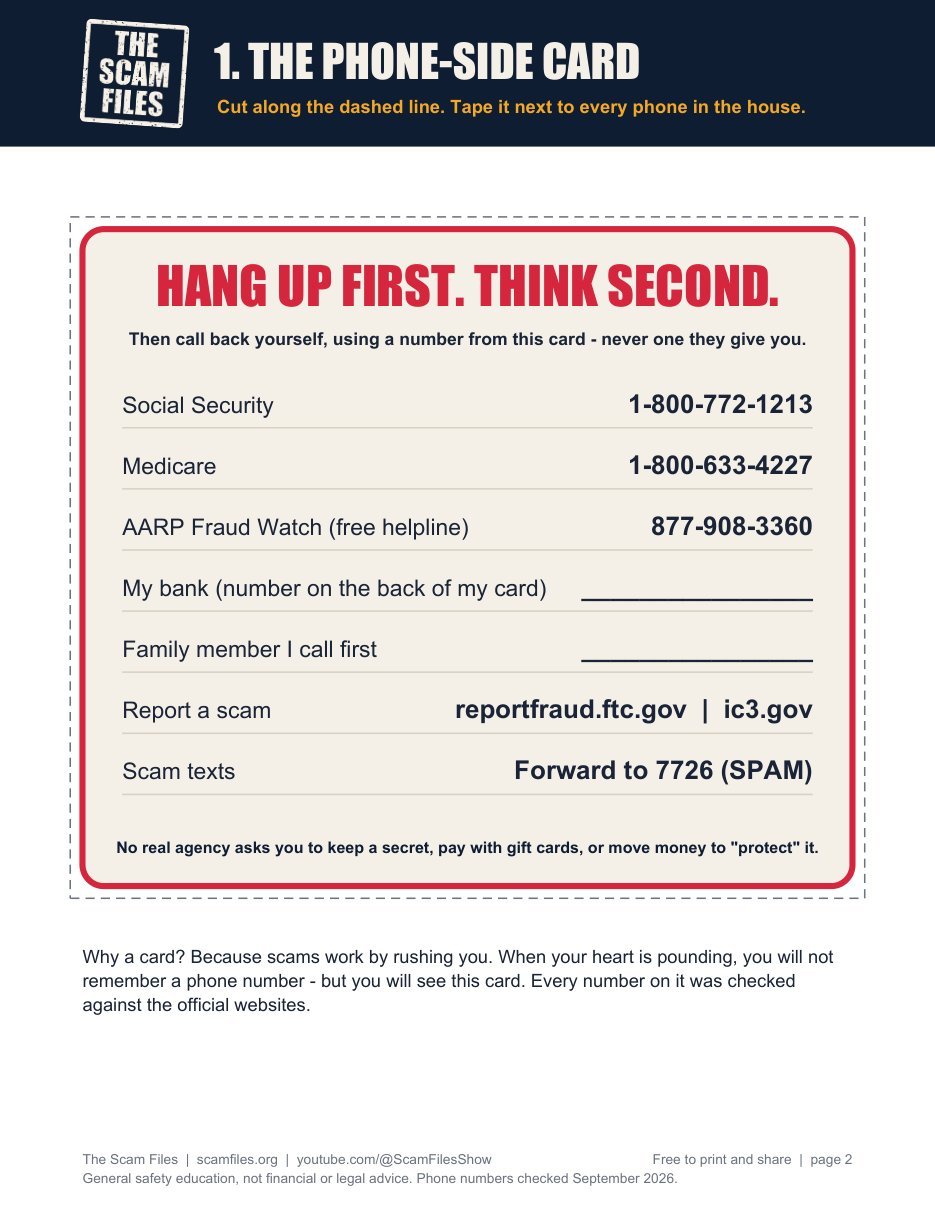
Keep this file by the phone
Print it and tape it by the phone. Six pages, free:
- The phone-side card with the real numbers
- 12 sentences that mean "hang up now"
- Your family safe word, and the 10 scams in one page
One short email a week with the newest case file. No spam, unsubscribe any time.