
The case file
The first message wasn't even meant for him. "Hi Linda, are we still on for golf Saturday?" Walter wrote back, the way he'd been raised to. "Sorry, I think you have the wrong number." That polite reply was stage one of seven.
Last week we opened the pop-up that says your computer is infected. We promised you the scam that doesn't ask for money at all in the first months. It asks for your trust, one kind message at a time, until the day it asks for everything. Tonight we open that file.
This one matters more than any file we've opened so far, and the numbers say why. According to the FBI's 2025 Internet Crime Report, cryptocurrency investment fraud was the single highest source of financial losses to Americans last year: seven point two billion dollars. Among Americans sixty and older, investment fraud losses nearly tripled in two years, to more than three and a half billion dollars. And the most common way into that fraud isn't a stock tip from a stranger. It's a friendship. Sometimes a romance.
What you're watching is a dramatization. Walter is a composite character. Every stage you're about to see comes from patterns documented by the FBI, the FTC and the SEC, and we'll put those sources on screen as we go. By the end, you'll know all seven stages by name, and the one moment where every single version of this scam can be stopped.
Stage one: the wrong number.
The message that reached Walter looked like a mistake, and that's the design. The FTC warns that these texts are built to look innocent: "Hello." "Are we still on for coffee?" "Is this David?" A kind person answers to help. The moment you do, you've confirmed a real, working number, owned by someone polite enough to reply to a stranger.
The sender apologized, warmly. Her name was Lin. She said most people never bother to answer, and it was refreshing to meet a gentleman. She asked where he lived. She said she'd always wanted to see that part of the country.
It doesn't always start with a text. The FTC says nearly sixty percent of people who lost money to a romance scam in 2025 said it started on social media: a friend request, a comment, a message on a dating app. The door is different every time. What happens after the door is always the same.
Stage two: the mirror.
Within a week, Lin was sending Walter a good-morning message every single day. When he mentioned his late wife, Carol, Lin said she'd lost her mother the year before, and she understood grief. When he mentioned he still built furniture in his garage, she said her father had been a carpenter. Whatever he offered, she reflected back, a little warmer. The FTC calls this out directly: scammers tailor their act to the details in your profile and your answers.
She sent voice notes, too.
Good morning, Walter. I was thinking about your workshop when I woke up. I hope you finish that rocking chair for your granddaughter. And I hope you eat a real breakfast today, not only coffee. Okay? Talk to you tonight.
"Lin"
Listen to what's missing from that message: a request. There isn't one. There won't be one for months. That patience is what makes this scam so hard to see from the inside, because every single warning you've ever heard says a scammer will ask you for money. Lin never did.
Stage three: the move.
About two weeks in, Lin said the texting app on her phone was glitchy, and asked if they could talk on WhatsApp instead. It sounds like nothing. It's a stage of its own for a reason. The FBI's description of this crime is almost word for word: the criminals make contact through texts, social media or dating apps, and then quickly move the conversation to a private messaging platform. Off the original app, there's no fraud filter watching, no one to report the profile to, and no record the platform can hand to investigators.
On WhatsApp, the photos kept coming: Lin at a waterfront café, Lin in a silk blouse in front of an office tower. Always beautiful. Always a photograph. When Walter asked about a video call, the camera was broken, or it was the middle of the night where she was. If you watched our fourth case file, you already know what a camera that never turns on means.
Stage four: the money talk.
Around week six, Lin mentioned, almost in passing, that she'd had a good day. Her uncle had taught her a method for trading gold and cryptocurrency, and she'd made enough that afternoon to take her whole team to dinner. She sent a screenshot of her account: a long green line going up. She didn't ask Walter to invest. She changed the subject.
He asked her about it the next day.
That is the entire trick of stage four. You're the one who brings it up. The FTC puts it plainly: romance scammers play the long game, and one day the conversation turns to money, and they offer to help you invest yours. Not borrow it. Grow it. And you are not being asked for a favor. You're being let in on a secret by someone who cares about you.
Walter, I don't want you to do anything you're not comfortable with, okay? I only tell you because I trust you. Start small. One thousand, only to learn. I will stay with you and show you every step. If you don't like it, you take it out. It's your money, always.
"Lin"
"It's your money, always." Hold on to that sentence. We'll come back to it.
Stage five: the small win.
Lin sent Walter a link to a trading website. It looked professional: live price charts, a customer-service chat, a mobile app to download. He deposited one thousand dollars. Within a week, his dashboard said he'd made three hundred and forty. So he tried to take two hundred out, just to be careful. And the two hundred dollars arrived in his bank account.
That was the most expensive two hundred dollars of his life.
That withdrawal is not a mistake the scammers made. It's bait, and it's deliberate. It proves the platform is real, so the next deposit feels safe. The FBI says victims of this fraud are shown fake profits and even offered loans to encourage larger investments. Walter moved fifteen thousand from savings. Then sixty thousand from his retirement account. By month five, the screen said his balance was two hundred and twelve thousand dollars.
None of it existed. The website was a set of numbers typed by the same people typing Lin's messages. The money he'd sent went into cryptocurrency wallets controlled by the criminals, usually within minutes of arriving.
And here's what the FBI found when it started calling victims directly. Under an effort called Operation Level Up, agents contacted thirty-seven hundred and eighty victims of cryptocurrency investment fraud in 2025. Seventy-eight percent of them had no idea they were being scammed. They thought they were getting rich. The FBI says those calls stopped one man from cashing out seven hundred and fifty thousand dollars from his four-oh-one-k, and stopped a woman from selling her house to invest half a million more.
Stage six: the squeeze.
Walter's granddaughter was starting college, and he decided to take out forty thousand dollars for her tuition. Instead of a transfer, he got a message from the platform's customer service.
Good afternoon, Mr. Hayes. Your withdrawal request has been approved, pending one final step. Under our compliance policy, the capital gains tax of eighteen percent must be settled before funds are released. That's thirty-eight thousand, one hundred sixty dollars. Please note it cannot be deducted from your balance and must come from outside funds.
"Customer service"
Remember what Lin told him: "It's your money, always." This is the moment it stops being his money, because it never was.
The FBI's own report describes this stage exactly: when victims try to withdraw, they're charged taxes and fees, as a final attempt to take more before the scammers disappear. And the fees never end. Pay the tax, and there's an anti-money-laundering deposit. Pay that, and your account needs an upgrade. Every fee comes with a deadline, and every deadline comes with the threat that everything will be frozen for good.
Here's the rule that ends stage six on the spot. No real brokerage, bank or trading platform makes you send in new money so you can take out your own. If you have to pay to withdraw, the money isn't there. It never was.
Walter stopped paying. Lin went quiet within a day. The WhatsApp number stopped answering. The website still showed two hundred and twelve thousand dollars, glowing green, for someone who would never see a cent of it.
That should be the end of the file. It isn't. There's one more stage, and it's the cruelest.
Stage seven: the second robbery.
Three weeks later, Walter got an email from a law firm. They said they specialized in recovering stolen cryptocurrency, that they were working with the FBI, and that his case had been referred to them.
Mr. Hayes, my name is Daniel Price, senior counsel with Whitmore Asset Recovery. First, I want you to know this was not your fault. We've traced your funds, and we're working alongside the FBI and the International Financial Trading Commission to have them released. There is a one-time retainer of ten percent, and I'd ask that you keep this confidential while the recovery is in progress.
The "lawyer"
He sounds kind. He says it wasn't your fault. That's exactly why it works on someone who has just lost everything.
The FBI has warned about these fictitious law firms by name. They claim to work with the FBI or other agencies. They mention official-sounding bodies like the "International Financial Trading Commission," which does not exist. They won't appear on camera. And they ask for a fee, in crypto or gift cards, before any money comes back. Just this summer, the FBI warned that criminals are even impersonating its own Internet Crime Complaint Center. So here are the FBI's own rules, word for word: IC3 will never directly contact you by phone, email, social media or chat, and IC3 will never ask for payment to recover lost funds. Law enforcement does not charge victims to investigate a crime.
This is where our dramatization turns.
Walter didn't answer the lawyer that night. That Sunday after church, he told his neighbor, Eleanor, because the lawyer had said to keep it confidential, and something about that sat wrong with him. Eleanor listened to the whole story without interrupting. Then she asked him one question, the same one someone once asked her: "Walter, did she ever once get on a live video call with you?"
He didn't need to answer.
Eleanor had been through a version of this herself, in our fourth case file, and she knew what came next. She sat with him while he called his bank's fraud line, using the number on the back of his card. Then they filed a report at I-C-3 dot gov together, at her kitchen table. The money Walter already sent is most likely gone, and we won't pretend otherwise. But the second robbery never happened, because he told someone before he paid.
Let's talk about why this works on careful, intelligent people, because it isn't greed. Walter wasn't trying to get rich. He was talking to someone who remembered his wife's name and asked if he'd eaten breakfast. The money came later, and it came wrapped in proof: a real two-hundred-dollar withdrawal, a real-looking app, a balance that grew every day. By the time anything looked wrong, he'd already put in so much that walking away felt like losing it all. That isn't foolishness. That's what a script designed by professionals does to anyone.
And the people typing those messages are often victims too. The FBI says these scams are largely run by organized criminal groups in Southeast Asia, using victims of human trafficking as forced labor in scam compounds. Lin is not one lonely con artist. She's a shift schedule, a script and a building full of people typing.
Last year, according to the FBI, more than twelve thousand Americans over sixty lost more than one hundred thousand dollars each to online fraud. If you're one of them, hear this: you were targeted by a business that does nothing else, all day, every day. The shame belongs to them.
Here is the playbook, all seven stages, so you can recognize it from the very first message.
One: the wrong number. Two: the mirror. Three: the move to a private app. Four: the money talk. Five: the small win. Six: the squeeze. Seven: the second robbery.
And here is the plan that beats every one of them.
Step one: don't answer wrong-number texts. Not even to be polite. Delete it, or forward it to seven seven two six, and move on with your day.
Step two: the moment someone you've never met in person brings up investing, crypto or gold, the relationship is over. Not paused. Over. There is no version of a real romance that needs a trading app.
Step three: never use a website or app that an online contact sends you. If you want to invest, check the firm and the person yourself, on FINRA BrokerCheck or at investor dot gov, before a single dollar moves.
Step four: if you have to pay to withdraw, the money isn't there. Stop sending, and call your bank.
Step five: nobody recovers stolen money for a fee. Not a law firm, not a "commission," not anyone claiming to be the FBI. Real law enforcement never charges you.
Step six: tell someone before you move money. A daughter, a neighbor, a friend from church. Every stage of this scam depends on you keeping it to yourself.
If you think this is happening to you, or to someone you love, stop sending money today. Save every message and screenshot before you block anyone. Call your bank's fraud department using the number on your card. Then report it to the FBI at I-C-3 dot gov, and to the FTC at report fraud dot F-T-C dot gov. If you're sixty or older, the Justice Department runs a free Elder Fraud Hotline: one, eight three three, FRAUD, one one. And AARP's Fraud Watch helpline is free, whether you're a member or not: eight seven seven, nine oh eight, three three six oh.
And if the loss feels like too much to carry, you don't have to carry it alone. You can call or text nine eight eight, any time, day or night.
In our dramatization, this is where the file closes: not with a stranger's promise, but with two neighbors at a kitchen table, and a phone number neither of them will ever reply to again.
So here's your homework. If someone in your life has a new online friend who talks about investing, send them this video, and ask them the only question that matters: "Have you ever seen them, live, on camera?"
This case file is closed. Next time, the text message about a package you never ordered, the one that spikes every holiday season. New file every week. Subscribe so you're never caught off guard.
- FBI IC3 — 2025 Internet Crime Report: https://www.ic3.gov/AnnualReport/Reports/2025_IC3Report.pdf
- FBI IC3 — Fictitious law firms targeting crypto scam victims (2025): https://www.ic3.gov/PSA/2025/PSA250813
- FBI IC3 — Scammers impersonating the IC3 (2026): https://www.ic3.gov/PSA/2026/PSA260720
- FTC — Reported losses to scams on social media (2026): https://www.ftc.gov/news-events/data-visualizations/data-spotlight/2026/04/reported-losses-scams-social-media-eight-times-higher-2020
- FTC — Wrong-number texts: https://consumer.ftc.gov/consumer-alerts/2024/05/why-its-not-rude-ignore-hi-how-are-you-text-messages-strangers
- SEC / FINRA / CFTC / NASAA — Relationship investment scams: https://www.investor.gov/introduction-investing/general-resources/news-alerts/alerts-bulletins/investor-alerts/relationship-investment-scams-investor-alert
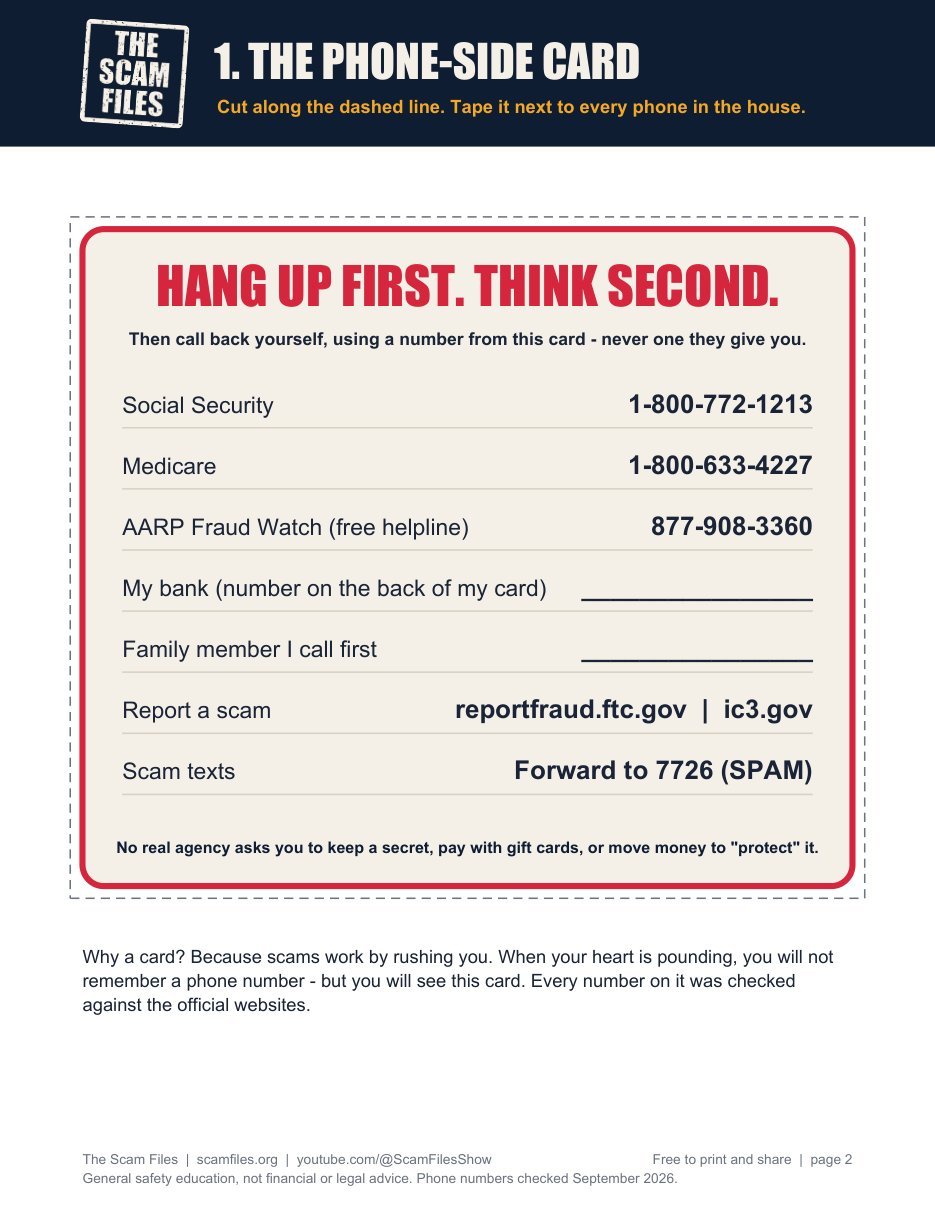
Keep this file by the phone
Print it and tape it by the phone. Six pages, free:
- The phone-side card with the real numbers
- 12 sentences that mean "hang up now"
- Your family safe word, and the 10 scams in one page
One short email a week with the newest case file. No spam, unsubscribe any time.