
The case file
The call says your Social Security number has been suspended. It sounds official. It sounds urgent. And it is completely fake. The Social Security Administration cannot suspend your number. It never has. But last year, Americans reported losing nine hundred and twenty million dollars to people pretending to be the government, and this call is one of their favorites.
I'm the host of The Scam Files, and this is Case File ten.
Last week, a text about a package. Tonight, a phone call, and the most dangerous thing about it isn't the threat. It's the help they offer you after the threat.
What you're about to see is a dramatization. Walter is a composite character, and every step you'll see comes from cases documented by the FTC, the Social Security Office of the Inspector General and federal prosecutors. We'll take the call apart line by line, show you where the money really goes, and then give you the one number that ends this scam in thirty seconds.
If you watched Case File eight, you've met Walter. He learned the hard way about strangers who text. So he made himself a rule: he doesn't answer messages from people he doesn't know. But this wasn't a message. It was a Tuesday morning, the kettle was on, and the phone on the kitchen wall was ringing. The caller ID said "Social Security Admin."
This is an important message from the Social Security Administration. Your Social Security number has been suspended due to suspicious activity. To avoid legal action, press one now to speak with an officer.
The recorded call
Walter pressed one. Almost everyone would. The recording didn't ask for anything. It just gave him a way to make the problem go away.
A man answered in under ten seconds. He gave a name, Officer Daniel Reed, and a badge number, and he spelled it slowly so Walter could write it down. Writing it down felt responsible. That's the point. Then the officer asked Walter to confirm the last four digits of his Social Security number, and before Walter could answer, the officer read them out himself.
That's the moment the call became real. How else could he know?
Here's how. Those four digits have been leaked in data breaches so many times that for most of us, they're not a secret anymore. They're for sale. The caller ID was fake, too. Scammers can make any name appear on your screen, including the government's.
Mister Hayes, I need you to stay calm and listen carefully. Two days ago, a rental car in your name was stopped near El Paso, Texas. Inside, agents found twenty pounds of drugs and bank statements linked to your Social Security number. We've also identified twenty-two bank accounts opened in your name. Now, I don't believe you did this. I believe your identity was stolen. But until we clear you, your number is frozen, and there is a warrant pending. I'm going to connect you to the federal agent handling your case. Do not hang up.
The "officer"
Listen to what he did there. First, the fear: drugs, a warrant, your name. Then, instantly, the relief: "I don't believe you did this." He's not your accuser. He's on your side. And from that second on, Walter wasn't trying to get away from the call. He was trying to get help from it.
The Social Security Inspector General has warned about exactly this story, including a fake letter that uses the words "suspension of Social Security number due to criminal activities," official-looking stamps, and a deadline of twenty-four hours. Some scammers even use the names of real government employees. The Inspector General's answer is simple: they will never send a letter like that. And Social Security will never tell you your number is suspended.
The second voice on the line was colder. More senior.
Walter, this is Special Agent Mark Collins. I'll be direct with you. We believe someone inside your bank is involved. So you cannot discuss this with bank staff, or with family, until the case is closed. The funds in your accounts are at risk of being seized. To protect them, we'll move them into a secure federal account, in your name, until your number is reactivated. Do you understand?
The "agent"
Let me stop the tape here, because this is the heart of the whole scam.
Notice they still haven't asked Walter to pay a fine. They've asked him to protect his money. The FTC calls this the "keep it safe" lie, and it's the reason these losses have exploded. For people sixty and older who lost more than a hundred thousand dollars to impersonators, reported losses went from fifty-five million dollars in 2020 to four hundred forty-five million in 2024. More than eight times higher, in four years.
And "don't tell your bank, don't tell your family" is not a detail. It's a wall. It cuts you off from every person who could stop it.
There are three ways the money leaves. They'll ask you to withdraw cash and feed it into a Bitcoin machine at a gas station. Or to buy gold bars or coins and hand them to a courier who comes to your door. Or to wire it to an account they control. Every one of those is a door that doesn't open back up.
Walter did what the agent said. He stayed on the line, the phone pressed to his ear, while he drove to his bank. The agent had given him a sentence to use. If anyone asks, say it's for a home renovation. He was told to take out thirty-eight thousand dollars in cash. A courier from the Treasury, the agent said, would come to his house that evening to collect it, and it would be returned in full when the case was closed.
Federal prosecutors in Missouri sentenced five people this year for exactly this kind of scheme. Couriers picked up gold bars and coins from elderly victims who had been told their savings were compromised. The overseas scammers behind them took an estimated nine point three million dollars. In Michigan, a man who ran the same playbook, telling victims their Social Security numbers had been compromised and that they had to convert their savings into cash, gold or silver, was sentenced to sixty-three years in prison.
Walter stood at the counter and slid the withdrawal slip across. The teller, a woman who'd seen him every month for fifteen years, looked at the amount, and then she looked at him.
Walter, that's a lot of cash. Is everything alright? You know, I have to ask. Is anyone on the phone with you right now telling you what to say?
The bank teller
Nobody had ever asked him that. And he couldn't answer it. He stood there with the phone against his chest, and the agent was still talking into it.
The teller didn't argue with him. She did something better. She asked him if there was someone he trusted he could call first. Just one person.
He called Eleanor.
Walter, listen to me. Hang up the phone. Right now, just hang up. Nobody from the government asks you to take out cash. Nobody. We'll call Social Security ourselves, on the real number, and if they say something's wrong, we'll deal with it together. But first, hang up.
Eleanor
He hung up. His hands were shaking.
Eleanor met him at the bank twenty minutes later, and they called Social Security together, on the number printed on Social Security's own website: one, eight hundred, seven seven two, twelve thirteen. The woman who answered checked his record. Nothing was suspended. There was no case, no warrant, no Agent Collins. His number was fine. It had always been fine.
That evening, a car slowed down in front of Walter's house, sat there for a minute with its engine running, and drove away. Nobody came to the door. There was nothing to collect.
Why does this work on careful people? Because Walter was careful. He'd learned not to trust strangers. But this call wasn't from a stranger. It was from the most trusted name in his life: the government that sends his check every month. The scam didn't beat his caution. It borrowed his respect for authority, and then it used his fear against him. Fear makes all of us obey faster than we think.
The plan
Here's the plan. Five rules, and you only need the first one to be safe.
Rule one: Social Security will never tell you your number is suspended. Your number cannot be suspended. If a call, a text, an email or a letter says it has been, that alone tells you it's a scam.
Rule two: hang up, and call back yourself. Don't press one, don't call the number they give you, don't stay on the line. Social Security's real number is one, eight hundred, seven seven two, twelve thirteen. Write it on a card and keep it by the phone.
Rule three: no government agency will ever ask you to move money to protect it. Not Social Security, not the FTC, not the FBI. Cash, gold, gift cards, a Bitcoin machine, a courier at your door. Every one of those is a scam, every single time.
Rule four: "Don't tell anyone" is the alarm. The moment someone tells you to keep a secret from your bank or your family, that's your signal to call both of them.
Rule five: let your bank be your backup. If a teller asks whether someone's on the phone with you, they're not being nosy. They're trying to save your money. Tell them the truth.
If it already happened
If this already happened to you, you're not alone, and there's help. Call your bank right away. Report it to the Social Security Inspector General at S-S-A dot gov slash scam, and to the FTC at report fraud dot F-T-C dot gov. If money was sent, file at I-C-3 dot gov. And if you'd like to talk it through with a real person, AARP's Fraud Watch helpline is free: eight seven seven, nine oh eight, three three six oh.
In our dramatization, this is where the file closes. Walter wrote Social Security's real number on an index card and taped it next to the phone on the kitchen wall. Under it, Eleanor wrote one more line: "Hang up first. Think second."
Your homework for this week: write that number down, one, eight hundred, seven seven two, twelve thirteen, and put it by your phone. Then send this video to one person who still answers every call.
This case file is closed. Next time: the call from your bank's fraud department, warning you about a suspicious charge. It sounds exactly like your bank. It isn't. New file every week. Subscribe, so you're never caught off guard.
- FTC — Imposter scams 2025 ($3.5B; government impersonators $920M): https://www.ftc.gov/news-events/news/press-releases/2026/06/ftc-data-show-people-reported-losing-3-point-5-billion-imposter-scams-2025
- FTC — Impersonators stealing $100k+ from older adults: https://www.ftc.gov/news-events/news/press-releases/2025/08/ftc-data-show-more-four-fold-increase-reports-impersonation-scammers-stealing-tens-even-hundreds
- SSA OIG — "Suspension of Social Security number" scam alert (Nov 2025): https://oig.ssa.gov/scam-alerts/2025-11-12-unexpected-letter-text-or-email-from-the-social-security-administration-office-of-inspector-general-think-scam-first/
- FTC — Social Security impersonators: https://consumer.ftc.gov/social-security-impersonators
- DOJ E.D. Missouri — gold couriers sentenced: https://www.justice.gov/usao-edmo/pr/five-sentenced-helping-overseas-scammers-defraud-elderly-victims
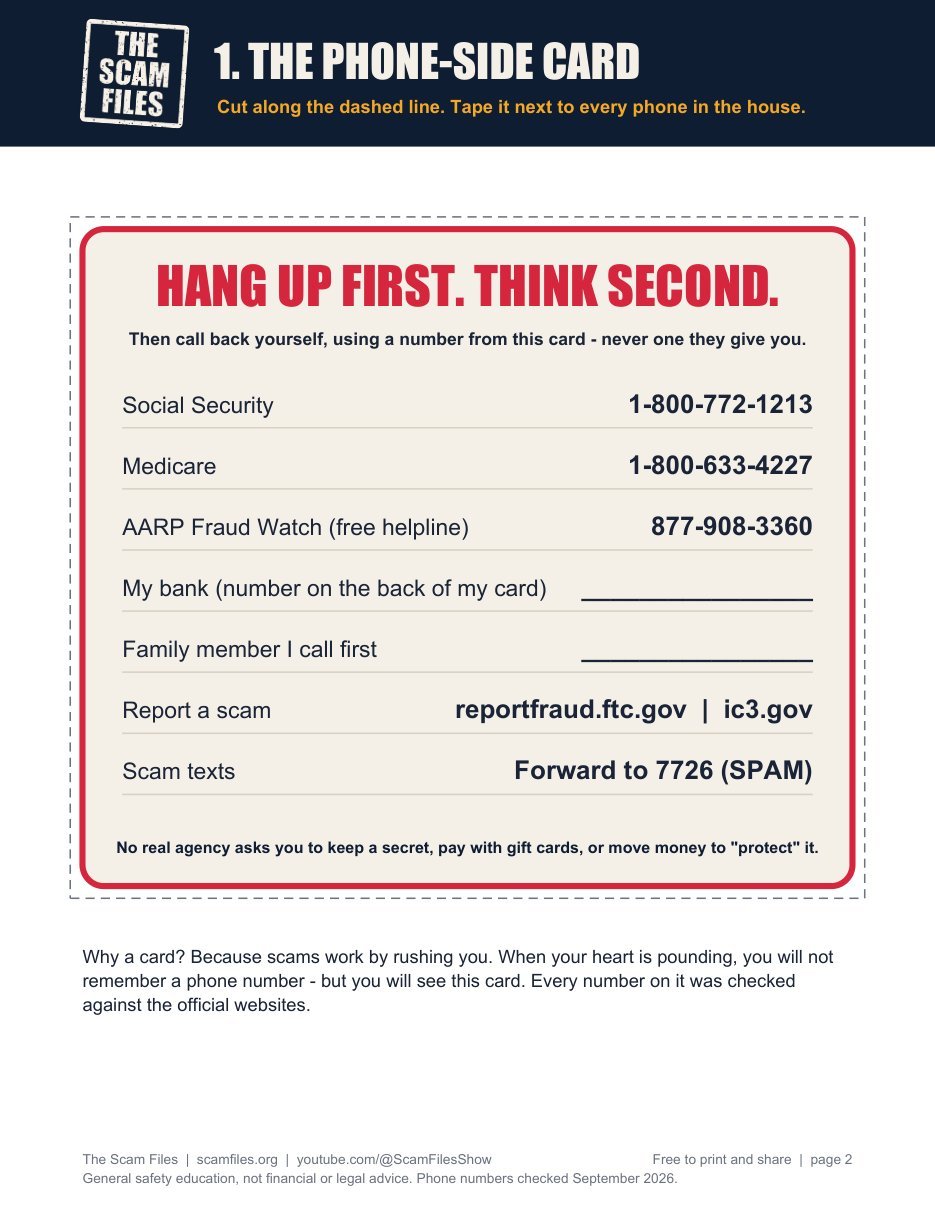
Keep this file by the phone
Print it and tape it by the phone. Six pages, free:
- The phone-side card with the real numbers
- 12 sentences that mean "hang up now"
- Your family safe word, and the 10 scams in one page
One short email a week with the newest case file. No spam, unsubscribe any time.