
The case file
In one month this year, Americans picked up one hundred and four million phone calls about Medicare. Medicare didn't make a single one of them.
Last week we gave your family a safe word. Tonight we open the file that scammers circle on their calendar. Medicare open enrollment runs from October fifteenth to December seventh, and for those seven weeks, sixty-eight million people are expected to think about their coverage, expect mail about their coverage, and take calls about their coverage. That expectation is the whole opportunity. Nobody hangs up on Medicare in October.
So tonight we're going to do something simple. You're going to hear five calls, the five that account for most of the damage, reconstructed word for word from the scripts that fraud investigators, the FTC and AARP have published. After each one, we'll show you the one sentence that gives it away, so that when the real thing rings, you'll recognize it before the caller finishes their first breath.
What you're watching is a dramatization. Eleanor is a composite character. Every call is real.
First, the rule that beats all five, straight from Medicare's own website: Medicare will never call you to sell you anything, and will never visit you at your home. If Medicare needs you, it writes. Hold onto that. Here's call number one.
Good afternoon, my name is Classy. I'm calling because your Medicare member profile hasn't been transferred into Medicare's national database for 2026 yet. When that transfer is missing it can cause delays in your coverage approvals. I can verify it real quick. You have both Part A and Part B, right? Great. Can you get out your red, white and blue Medicare card for me?
Call 1
That is not a movie script. That is the exact wording of a robocall that reached seven point six million Americans in May of this year, according to the call-blocking company Nomorobo. There is no national database transfer. There is nothing to verify. Medicare already has your Medicare number; it issued it. The only person on that call who doesn't have it is Classy.
And that number is the entire prize. Here's why. Your eleven-character Medicare number is a billing key. Whoever holds it can charge Medicare for equipment you never received, tests you never took, and visits that never happened. In June of last year the Justice Department announced the largest health-care fraud takedown in American history: three hundred twenty-four defendants and fourteen point six billion dollars in fraudulent claims. One operation alone billed ten point six billion dollars for urinary catheters, using the stolen identities of more than a million Americans. Most of them never lost a dollar from their own account. They lost something quieter: their number, their medical record, and eventually, their benefits. Call number two.
Hi, this is Daniel with Medicare Services. Good news: the new plastic Medicare cards with the security chip are being mailed out this month, and yours is ready. I just need to confirm the number on your current paper card so we can activate the new one. There's no charge for the card itself, we just need to verify the number and a shipping address.
Call 2
Two words give it away: chip card. There is no Medicare chip card. There is no plastic upgrade. There is no activation. The red, white and blue paper card is the card, and if you ever need a replacement, it's free, in about a minute, from your own account at Medicare dot gov. A caller offering you a better card is offering you nothing and asking for everything.
Notice what Daniel did, though, because it's the pattern for the whole season. He didn't ask you to pay. Scammers learned years ago that "send money" makes people hang up. "Confirm the number you already have" doesn't feel like giving anything away. It feels like paperwork. Call number three.
Hi there! I'm reaching out because Medicare has approved you for a brand new orthopedic back brace at no cost to you, one hundred percent covered. We can also include the knee braces if you've had any pain there. All I need to get that shipped out today is the Medicare number on your card, and your doctor will sign off on our end.
Call 3
Free. That's the word. A free brace, a free genetic test for cancer risk, a free glucose monitor. AARP has tracked these calls for years and the shape never changes: the item is real, or a cheap version of it arrives in the mail, and Medicare gets billed for hundreds, sometimes thousands of dollars. The brace is bait. Your number is the catch.
And here is the part that most people don't know. When Medicare pays for a brace you didn't need, that brace is now in your file. Six months later, when your own doctor orders the one you actually do need, the claim can be denied, because according to Medicare, you already have one. The FTC estimates that fraud, errors and abuse cost the program about sixty billion dollars a year. That's the taxpayer's problem. The denied claim is yours. Call number four.
Ma'am, I'm a licensed Medicare agent and I'm calling because your current plan is being discontinued in your county for 2027. If you don't move to a replacement plan before the deadline, you'll have a gap in coverage in January. I can enroll you right now over the phone, it takes five minutes, but I do need to do it today.
Call 4
This one is the most dangerous, because some of it is true. Plans do change. Some are discontinued. And starting this year, a federal rule change means you will genuinely get more sales calls and more mailers from real agents than ever before. That's exactly what the fake ones are counting on.
So here is the rule that separates them. Under federal regulation, an agent may not call you about a Medicare plan unless you asked them to. No permission, no call. A real agent you never contacted is breaking the rules; a fake agent is running a script. Either way, the answer is the same, and it's the only sentence you need for the entire enrollment season: "I'll look into it myself." The real deadline is December seventh, not today, not this call. And you never have to make the decision alone. Every state has a free, unbiased counseling line for exactly this, called SHIP, and the number to Medicare itself is on the back of your card. Call number five.
This is the Medicare Reimbursement Department. Our records show you were overcharged for premiums during the last plan year and you're entitled to a refund of four hundred and eighty-six dollars. To process the deposit I'll need to confirm the account and routing number where you'd like the refund sent.
Call 5
Nobody calls to give you money. Medicare does not have a reimbursement department that phones people, and if you were ever owed anything, it would arrive the way everything from the government arrives: on paper, or in an account you already set up yourself. This call is a government imposter, and in 2025, Americans reported losing nine hundred and twenty million dollars to government imposters, according to the FTC. People over fifty reported four point three billion dollars in fraud losses last year, nearly double the losses of everyone younger.
Five calls. Now let's watch what happens when Eleanor gets one.
The phone rings. The caller ID says Medicare. She listens for exactly as long as it takes to hear the words "confirm your Medicare number." And then she does the only thing that works. She says, "I'll call Medicare myself," and she hangs up. No argument. No explanation. She turns the card over and dials the number printed on the back, and in two minutes she knows there was no database, no chip card, no brace and no refund.
The plan
Here is the plan for the whole season. Four steps.
Step one: hang up and call back. Any call about Medicare, from anyone, ends with you dialing 1-800-MEDICARE yourself, from the number on your card. Not the number they give you. Not the one on your caller ID, which can be faked.
Step two: guard the number like a credit card. Your doctor, your pharmacist, your plan, and a SHIP counselor. That's the list of people who ever need it. Nobody who calls you is on that list.
Step three: read the statement. Every three months Medicare sends you a Medicare Summary Notice, or you can see claims online within a day. Look for things you didn't get: a brace, a test, a visit. That's how this fraud is caught, and it's caught by ordinary people at kitchen tables far more often than by investigators.
Step four: report it, and do it in one call. The Senior Medicare Patrol is a free, nationwide program built for exactly this. Their number is 877-808-2468. They'll help you read the notice, file the report, and fix your record if someone has already used your number.
A few weeks after our call, Eleanor and Chloe sit down with the quarterly notice. Halfway down page two there's a line: an orthopedic brace, nineteen hundred dollars, billed from a supplier in a state she's never visited. She never gave anyone her number. It was taken years ago, in a data breach she never heard about, and it has been quietly for sale ever since. That's the last lesson of this file: even if you never picked up a single one of these calls, read the statement anyway. The number may already be out there. The notice is how you find out.
One more thing. If you have a parent or a neighbor on Medicare, forward them this video before October fifteenth, and ask them one question: "When the phone rings and it says Medicare, what do you do?" If the answer is "hang up and call the number on my card," you've done more than any government agency can.
This case file is closed. Next time, the pop-up that says your computer is infected, and the phone number on it that you must never call: the tech-support scam that took more than a billion dollars from Americans over sixty last year.
New file every week. Subscribe so you're never caught off guard.
- Medicare — Reporting fraud and abuse: https://www.medicare.gov/basics/reporting-medicare-fraud-and-abuse
- FTC (May 2026) — Medicare fraud affects everyone: https://consumer.ftc.gov/consumer-alerts/2026/05/medicare-fraud-affects-everyone-so-heres-what-know-and-do
- DOJ / CMS — 2025 National Health Care Fraud Takedown, $14.6 billion: https://www.cms.gov/newsroom/press-releases/national-health-care-fraud-takedown-results-324-defendants-charged-connection-over-14-6-billion
- FTC — Imposter scam losses, 2025 data: https://www.ftc.gov/news-events/news/press-releases/2026/06/ftc-data-show-people-reported-losing-3-point-5-billion-imposter-scams-2025
- AARP — Medicare scams: https://www.aarp.org/money/scams-fraud/medicare/
- Nomorobo — the "national database" robocall alert: https://www.nomorobo.com/medicare-fraud-alert-fake-national-database-robocalls-flooding-phones/
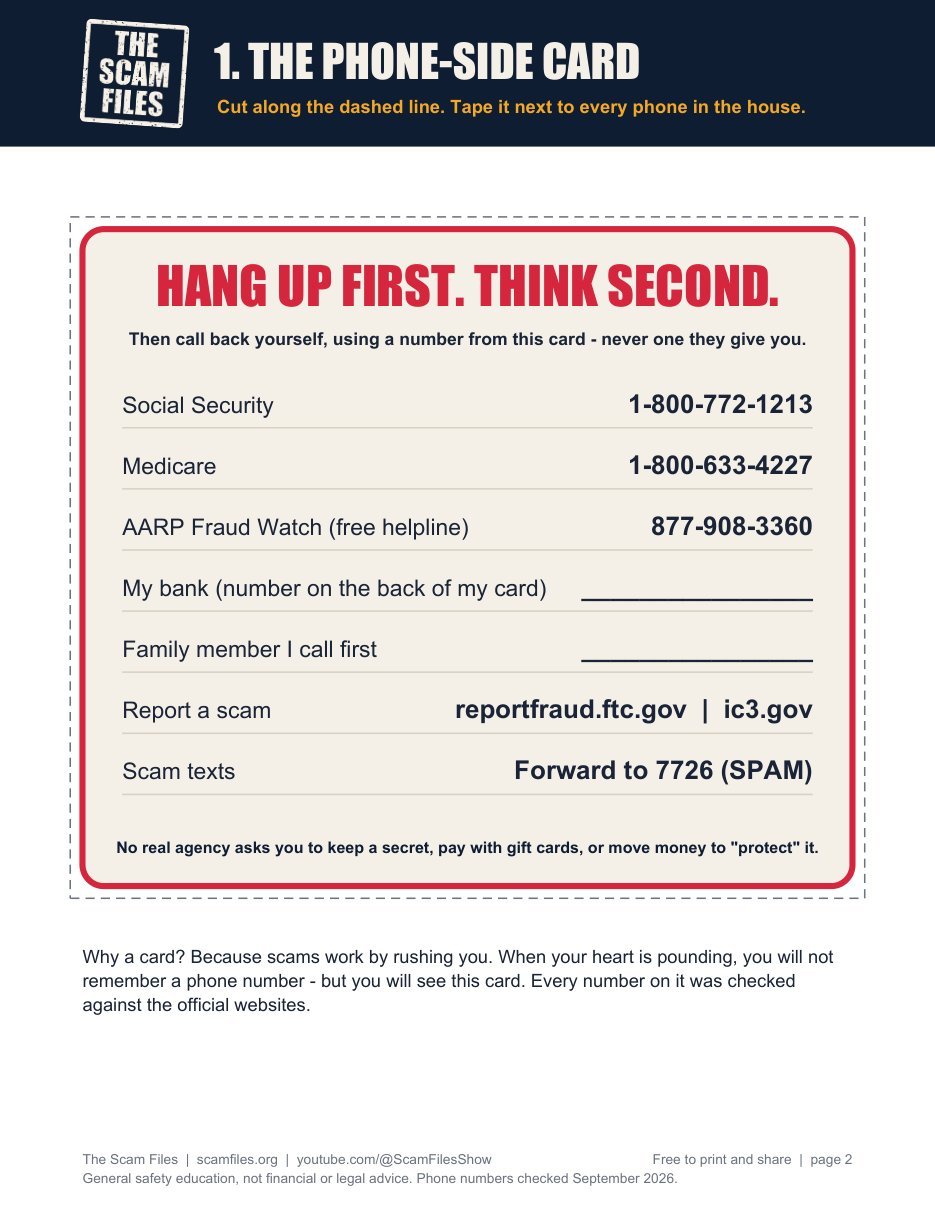
Keep this file by the phone
Print it and tape it by the phone. Six pages, free:
- The phone-side card with the real numbers
- 12 sentences that mean "hang up now"
- Your family safe word, and the 10 scams in one page
One short email a week with the newest case file. No spam, unsubscribe any time.