
The case file
The phone rings at 11:40 at night. It's her granddaughter's voice — crying, in trouble, begging her not to hang up. Every word is real. Except the person saying them doesn't exist.
Four weeks ago, we opened the file on the man who wooed a widow for eight months without ever turning his camera on. Tonight the file is smaller, faster, and far more common: the family emergency call. And instead of showing you how it works and telling you to be careful, we're going to do something better. By the end of this episode you'll have set up the one five-minute habit that makes this entire category of scam collapse on contact. It's free. It works even if the voice is perfect. And it works even if you're the kind of person who would never, ever fall for this.
What you're watching is a dramatization. Eleanor and Chloe are composite characters — but every step comes from cases documented by the FBI, the FTC and AARP, and we'll put those sources on screen as we go.
Here is how the call is built. Chloe is twenty-six. Last summer she posted a forty-second video from a friend's wedding — a toast, a laugh, her voice clear as a bell. According to a McAfee survey of seven thousand adults, three seconds of audio is enough to produce a clone that matches the original voice about eighty-five percent of the way. Forty seconds is a luxury. The software is free. The script is older than the software: I'm in trouble, I'm scared, please don't tell Mom, I need the money tonight.
Then they pick the target. Not Chloe. The person who would do anything for Chloe.
Grandma? Grandma, it's me — please don't hang up. There was an accident, it wasn't my fault, I'm at the station and they won't let me leave. There's a lawyer here, he says if the bail isn't paid tonight I have to stay. Please, Grandma. Please don't call Mom.
The caller
That was one version of the call. There are three, and they rotate.
The first is the one you just heard: an accident, an arrest, a lawyer, bail money tonight. The second is the hospital: a crash, surgery, a hospital administrator who needs a payment before treatment. The third is the cruelest, and it is spreading fast: a voice screaming that they have been taken, and a second voice, calm and adult, who tells you not to hang up and not to call the police.
None of these calls are new. What is new is that the voice is now perfect, and the software that makes it is free.
Before we go further, understand where that voice came from, because it did not come from a hacker.
It came from a birthday video. A church livestream. A sideline clip from a grandson's game. Forty seconds of a wedding toast, posted publicly, with a caption that says who everyone is. And in a lot of cases it comes from something even simpler: the outgoing message on a voicemail. Seven seconds of "Hi, you've reached Chloe, leave a message" is more than the software needs.
The name is easy too. Obituaries list survivors. Public family posts tag them. Data brokers sell the phone number that goes with the address. By the time the phone rings, the caller already knows who Eleanor is, who Chloe is, and which one of them would drive to the bank at midnight.
Then there is the number on the screen. Caller ID can be faked to show anything: a local area code, a police department, even a family member's own number. The FCC says it plainly: assume the number is not proof of anything.
And notice how the money is supposed to move. Never a check. Never a card with a dispute button. It is a wire, or gift card numbers read out loud over the phone, or cash into a crypto machine, or the newest version: a polite young man who arrives at the front door in a rental car to collect an envelope, because the lawyer said a courier would come.
Every one of those steps is designed for one reason. To make sure that by the time somebody real is on the line, the money is already gone.
Stop there and notice what that call did. It gave her a voice she loves. It gave her a reason not to check with anyone else. And it gave her a clock. Those three moves — the voice, the isolation, the deadline — are the entire scam. Everything after that is just collecting the money.
And it collects a lot of it. In 2025, the FBI's Internet Crime Complaint Center logged more than two hundred thousand complaints from Americans over sixty, with reported losses above seven point seven billion dollars — up thirty-seven percent in a single year. The average loss for a victim over sixty was about thirty-eight thousand dollars. And the FTC's own research suggests fewer than one in twenty victims ever report at all. Those numbers are the floor, not the ceiling.
So why does it work on smart people? Because the defense we've all been given is impossible. "Listen carefully and you'll notice something off." In that same McAfee survey, seventy percent of adults said they were not confident they could tell a cloned voice from a real one. One in four said it had already happened to them or to someone they know. Asking a grandmother to out-hear a machine at midnight is not a plan. So we're not going to ask her to.
The plan
Here is the plan. The FTC, the FCC and AARP all recommend the same thing, and it takes five minutes. It's called a family safe word.
Step one: pick it. One word, or a short phrase, that lives only in your family's memory and nowhere online. The name of the dog you had in 1994. The thing Grandpa always said at the end of dinner. Not a birthday. Not a street. Nothing a stranger could find in a photo caption.
Step two: share it out loud. Not in the family group chat. Not in a text. Say it at the table, on a real call, face to face. If it's written anywhere, it's not a secret.
Step three: rehearse the rule. Any call, any voice, any emergency — before a single dollar moves, the person on the phone says the word. If they can't, or they get angry, or they say there's no time, the answer is: "Then I'll hang up and call you back." And you call the real number you already have.
Step four: make it normal. Tell the grandkids this isn't about doubting them — it's a two-second password, like the one on their phone. Families that treat it as routine use it. Families that treat it as an insult forget it.
Watch what happens to the same call now.
Eleanor hears the voice. She feels everything she felt before. And then she asks one question: "Sweetheart — what's our word?" There is a pause on the line. The pause is the whole answer. She hangs up, she calls Chloe's real number, and Chloe picks up from her couch, watching television, completely fine.
That's it. No app. No expensive service. The most advanced fraud technology in the world, beaten by a family joke from 1994.
Now let's make your word a good one, because most families pick a bad one on the first try.
A bad word is anything a stranger could find or guess. Not a birthday. Not a street you lived on. Not the school, not the wedding anniversary, and not the dog whose photo is on your daughter's public page with his name in the caption.
A good word lives only in the family's memory. The nickname a two-year-old gave the vacuum cleaner. The line your father said at the end of every dinner. The dish Grandma always burns. Something with no paper trail and no post attached to it, that everyone in the family can say without thinking.
And when you use it, expect pushback, because the caller has heard it before. So here are the three sentences that end the call. If they say there is no time: "Then there is no money." If they get angry: "If you are who you say you are, you know the word." And the one that works every time: "I'm going to hang up and call you back."
Two more layers while you're at it. Change the voicemail greeting on every phone in the family so it doesn't say the name in the owner's own voice. And if you are the grandchild, set your accounts to friends only, and tell your grandparents the word yourself, out loud, so the first time they hear it isn't from a stranger.
Five minutes. One phone call. That is the whole defense.
If it already happened
If a call like this already got through — if money already moved — do these things tonight. Call your bank and ask to reverse the payment; the sooner you call, the better the odds. Save the number that called you and every message. Report it at IC3.gov and ReportFraud.ftc.gov, because those reports are how these rings get mapped. And call AARP's free Fraud Watch helpline at 877-908-3360 to talk to a real person about the next step.
One more thing, and it's the most important. Set the word up tonight — not this weekend, not after the holidays. Tonight. Call one person in your family before you go to bed, and agree on it. That's the whole homework.
This case file is closed. Next time, the season that scammers circle on their calendar: Medicare open enrollment starts October fifteenth, and the phone calls have already begun.
New file every week. Subscribe so you're never caught off guard.
- FTC — Scammers use AI to enhance their family emergency schemes: https://consumer.ftc.gov/consumer-alerts/2023/03/scammers-use-ai-enhance-their-family-emergency-schemes
- FBI IC3 — Internet Crime Report, victims 60+: https://www.ic3.gov/AnnualReports/Reports
- McAfee — The Artificial Imposter survey (7,054 adults, 7 countries): https://www.mcafee.com/ai/news/ai-voice-scam/
- AARP Fraud Watch Network — Grandparent scams: https://www.aarp.org/money/scams-fraud/grandparent/
- FCC — Grandparent scams get more sophisticated: https://www.fcc.gov/consumers/scam-alert/grandparent-scams-get-more-sophisticated
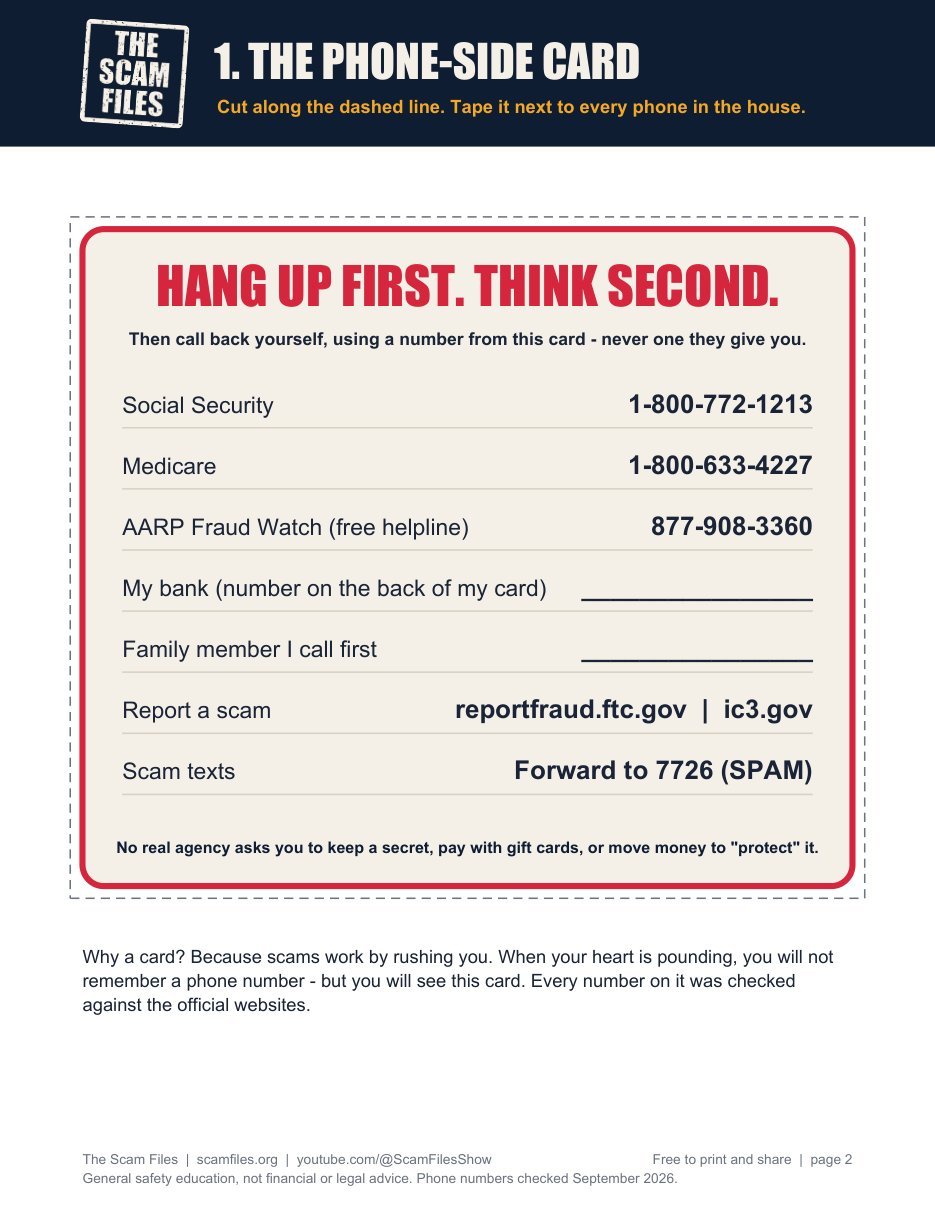
Keep this file by the phone
Print it and tape it by the phone. Six pages, free:
- The phone-side card with the real numbers
- 12 sentences that mean "hang up now"
- Your family safe word, and the 10 scams in one page
One short email a week with the newest case file. No spam, unsubscribe any time.