
The case file
For eight months, Eleanor talked to this face almost every day. He'd written her poetry. He knew her late husband's name, her granddaughter's birthday, the hymn she wanted played at her own funeral one day. And in eight months, his camera never once finished loading.
Three weeks ago, we showed you the message that looked exactly like your bank. Tonight we open the file on something that doesn't ask for your money in one message — it asks for your heart first, patiently, for months, and your money only after it already has both. By the end of this episode, you'll know the six words a real match will never say, and the one habit that stops this before it starts.
What you're watching is a dramatization. Eleanor is a composite character — but every step comes from patterns documented by the FBI and the FTC, and we'll put those sources on screen as we go.
He messaged her first, three months after her husband passed, on an ordinary dating app. His profile said he was an American engineer, currently on a contract overseas — an oil platform, a UN project, a military deployment; the story changes, the excuse for the distance never does. They talked for hours. He asked careful, generous questions and remembered every answer. He never once asked her for money. Not for the first month. Not for the second.
That patience is the method, not an accident. According to the FTC, people who report losing money to a romance scam say the relationship lasted a median of seven months before any money changed hands — long enough for a real bond to form in her mind, even though the man on the other end of it never existed.
Then came the ask — small at first. His equipment fees. A customs hold on a gift he was shipping her. Never a request; always a problem she could solve for someone she loved, for a few hundred dollars, paid back the moment his contract cleared. She sent it. He thanked her like it mattered more than the money.
My Eleanor — I am so ashamed to even ask. The company says my final payment is frozen until I clear this customs fee. The moment it clears, I am coming home to you. I promise you that.
"Marcus"
The next request was larger. Then larger still — an emergency surgery for a daughter Eleanor had never met, a bribe to get him off the platform and onto a flight home. Each one came with a reason his own money couldn't reach him yet, and a video call that buffered and froze the instant she asked to just see his face, one more time, to be sure.
This is where our dramatization turns. Her granddaughter didn't take the laptop away. She asked one question, gently: "Grandma, when's the last time his video actually loaded — all the way, no freezing?" Eleanor went quiet. She realized she couldn't remember a single time.
Let's look at the two tools that made "Marcus" feel real enough to love. The first is simply theft — of a face. The FBI's Internet Crime Complaint Center confirms romance scammers routinely lift photos from real people's public social media — service members, doctors, engineers — who have no idea their face is being used to build a fake identity thousands of miles from where they actually live.
The second tool is scale and patience run by teams, not individuals. The FTC reports Americans lost more than 1.1 billion dollars to romance scams in a single recent year, with a median individual loss around 2,000 dollars — and for victims over 70, the median loss climbs sharply higher, because the scripts are built for exactly the kind of trust a lifetime of good relationships teaches you to give.
And the excuse for never appearing on camera has its own name: the frozen call, the broken microphone, the "military security" that forbids live video — the FBI notes these are near-universal scripted responses, because a live, working video call is one of the fastest ways to break the illusion entirely.
This isn't hypothetical. AARP's Fraud Watch Network has documented cases of widowed and divorced adults over 60 sending six-figure sums over a period of years to online partners who never once met them in person — often draining retirement accounts to keep sending "just one more" payment to bring them home.
Why does this work on smart, self-aware people? Because it isn't targeting your bank account first. It's targeting the very real, very human ache of being alone after decades of not being alone — and it answers that ache with exactly the right words, for exactly as long as it takes.
And let's say it plainly, because it matters: if this has happened to you, you weren't foolish, and you weren't lonely in some way that made you an easy target. You were capable of loving someone, which is not a flaw. The only new information you need is what a real long-distance partner will actually do — and the one habit that catches a fake one before the first dollar ever moves. This is the Heart Check.
Step one: video call first. Before real feelings deepen, ask for one uninterrupted, unscheduled video call — not a "scheduled" one, right now, this minute. A real person can do this. A stolen photo cannot. If it "won't connect" more than once, that's your answer.
Step two: reverse image search. Save their profile photo and search it. If the same face shows up under three different names, three different countries, or a real person's unrelated social media, the profile is stolen. This takes ninety seconds and ends most of these before they start.
Step three: never send money. Not for customs fees. Not for a medical emergency. Not for a flight home. Not gift cards, not wire transfers, not cryptocurrency — to anyone you have not met in person, full stop, no matter how urgent or how small the ask sounds the first time.
Step four: tell someone early. Tell a family member about the relationship in month one, not after money has already moved. Scammers work hard to isolate you from the people who'd ask the one question they can't answer — so answer it for yourself, out loud, to someone else, early.
Video call first. Reverse image search. Never send money. Tell someone early. Four habits, and the love that looked so real never gets the chance to cost you anything but time.
If you think you've sent money to someone you've never met in person, do these things today. Stop all contact and all further payments immediately, save every message and photo before you block them, and call your bank to ask about reversing any wire or gift-card payment — the sooner you call, the better the odds. Then report it to the FBI at IC3.gov and the FTC at ReportFraud.ftc.gov; those reports are how investigators connect scripts used across thousands of victims to the same networks. And if you'd like to talk it through with a real person first, AARP's free Fraud Watch helpline is 877-908-3360, whether you're a member or not. Remember what we've said every time: being targeted by professionals is not a mistake you made — and needing love is never something to be ashamed of.
In our dramatization, this is where the file closes: not with an empty retirement account, but with a grandmother and a granddaughter closing the laptop, and opening an old photo album instead.
So here's your homework, and it's a five-minute one: if you or someone you love has an online relationship with someone they've never met in person, ask for that one unscheduled video call this week. Then tell one person in your family the four habits: video call first, reverse image search, never send money, tell someone early.
And if you'd like company doing this every week, subscribe. Next time, we open a file on the "job" that pays you to just deposit a check — and forward the difference. Until then: love is real. The camera that never turns on usually isn't.
I'll see you at the next file.
—
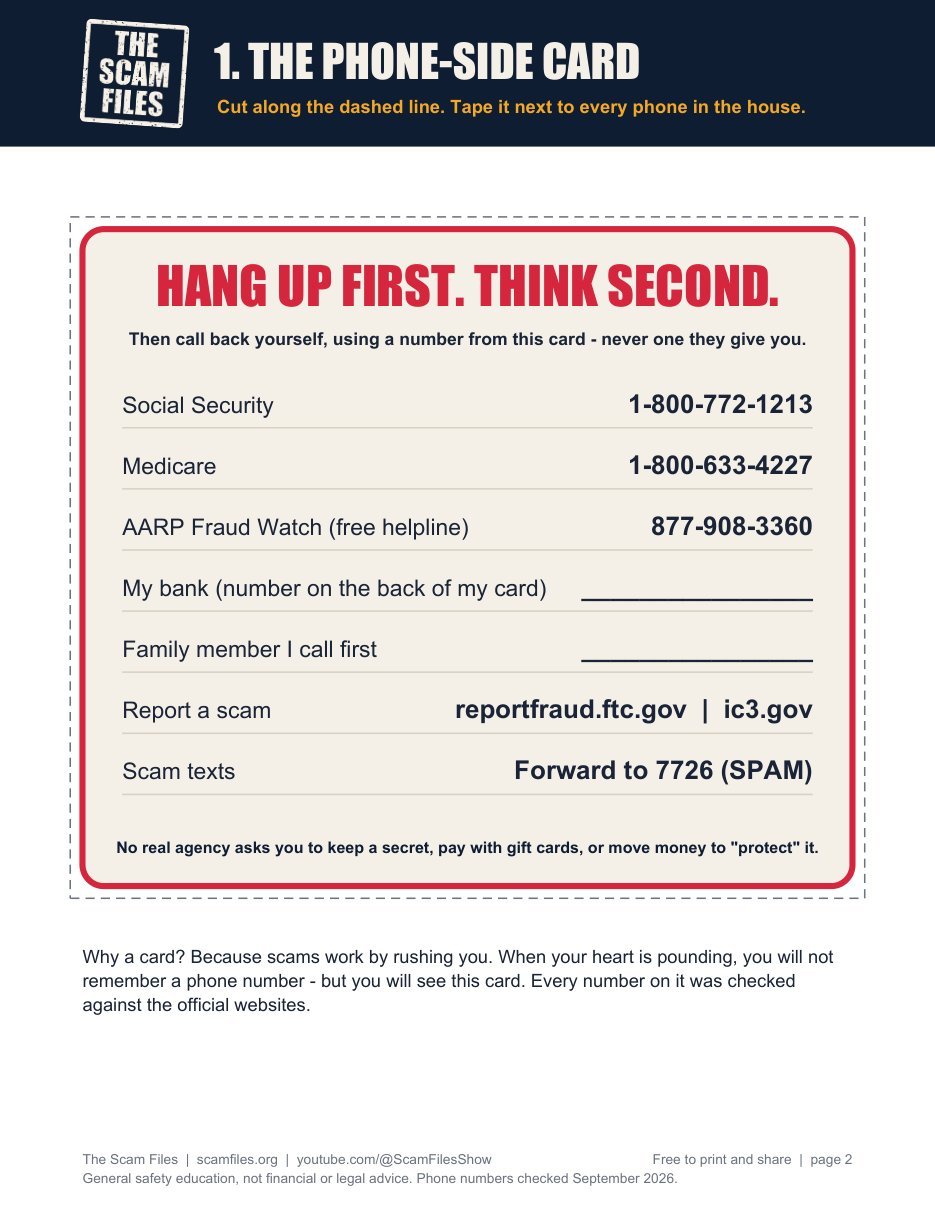
Keep this file by the phone
Print it and tape it by the phone. Six pages, free:
- The phone-side card with the real numbers
- 12 sentences that mean "hang up now"
- Your family safe word, and the 10 scams in one page
One short email a week with the newest case file. No spam, unsubscribe any time.