
The case file
It had the right blue logo. The right typeface. It even had the last four digits of her real card number. So when Margaret's phone buzzed with a fraud alert on a Tuesday evening, she did exactly what the message told her to.
Two weeks ago, we opened the file on where scammers steal your voice. Tonight, we open the file we promised you then: the message that looks like it came from your bank — down to the logo, the phone number, and the fear. By the end, you'll know the four things a real bank will never do, and the one thing you should never do back.
What you're watching is a dramatization. Margaret is a composite character — but every step comes from methods documented by the FBI, the FTC, and reported by real newsrooms, and we'll put those sources on screen as we go.
The text told her the same thing real banks say: unusual activity, tap to confirm, or call this number right away. She didn't tap the link. She's careful — she called the number instead. That felt safe. It was the first mistake, and it wasn't her fault, because the number she called was sitting right there in the message the whole time.
Here's the tell, and it's the one thing to remember from this entire episode: her actual bank app showed nothing. No alert, no charge, no $891.42. The text hadn't come from Chase. It had come from a scammer who didn't need to hack her account — he just needed her to believe the message, and dial the number printed underneath it.
On the other end was someone who sounded exactly like a bank employee — calm, professional, reading her account details back to her, which he'd bought from a previous data breach, not guessed. He told her a fraudulent charge was already moving through her account, and that he could reverse it right now, if she stayed on the line.
I'm sending a six-digit verification code to your phone now — just read it back to me so I can cancel that charge.
The "agent"
That code was not a cancellation code. It was the one-time passcode her real bank uses to approve a money transfer — a Zelle payment, a wire, a new payee. The moment she read it back, she wasn't stopping a charge. She was authorizing one.
This is where our dramatization turns. Michael had heard this call before — not this exact one, but the shape of it — because two weeks ago, this channel taught his family the Lockdown Plan. He didn't grab the phone. He just asked her one question, quietly: "What's the safe word?" There was a pause on the line. Then it went dead.
Let's look at the two tools that made this call feel so real. The first is caller ID spoofing. The Federal Communications Commission confirms that under the Truth in Caller ID Act, criminals can transmit false information to your phone, making any name and number appear on your screen — including your real bank's actual published number, the one printed on the back of your card. Seeing your bank's name and number on a call is no longer proof it's your bank.
The second tool is the message itself. The FTC reports that Americans lost 470 million dollars to scams that started with a simple text in 2024 alone — five times what was reported just four years earlier. And in the agency's own analysis, bank impersonation is consistently the single most reported type of text scam, with reports of texts pretending to be from banks up nearly twentyfold since 2019.
And the scale of what those calls and texts are draining is real: since January of last year, the FBI says criminals impersonating banks and financial institutions have stolen more than 262 million dollars from account takeover schemes just like the one you saw tonight — over 5,100 reported cases.
This isn't hypothetical. In one case reported by Fox Business, a Chase customer said the fraud callers had her account balance down to the penny, and even gave her a fake FBI agent number for credibility. She transferred nearly 40,000 dollars to what she believed was a "secured" account before the money vanished the same day.
Why does this work on smart, careful people? Because the entire scheme is built to feel like the responsible thing to do. You didn't click a suspicious link — you called a number. You didn't argue with the agent — you cooperated, because cooperating is how fraud actually gets fixed at a real bank. Criminals aren't exploiting carelessness here. They're exploiting good manners and quick thinking, aimed in the wrong direction, under a countdown clock they invented.
And let's say it plainly, because it matters: if this has happened to you, you didn't fail a test. You passed every instinct that keeps you safe in every other situation. The only new information you need is this — what a real bank will never ask for, and what to do in the sixty seconds after that first buzz on the counter. This is the Alert Plan.
Step one: hang up. It doesn't matter how professional the caller sounds, or how accurate your own account number sounds coming out of their mouth. A real bank will never be offended by you hanging up and calling back. There is no fraud emergency on earth that requires you to stay on that specific line.
Step two: call the bank. Not the number in the text. Not the number that just called you, even if your screen says it's your bank's real name. Turn over your debit or credit card and dial the number printed on the back, or open your bank's official app. That number was never in the scammer's hands.
Step three: never click. Don't tap links in unexpected texts about your account, ever — not to "verify," not to "cancel," not to "confirm you're not a robot." Go around the message entirely.
Step four: check the app. Before you believe any alert, open your bank's app yourself, the same way you always do, and look for the charge. If it isn't there, the text isn't real, full stop. And one sentence to remember longer than any of these four steps: a real bank employee will never ask you to read back a one-time passcode. That code is never for them. It's only ever for you.
Hang up. Call the bank. Never click. Check the app. Four habits, and the alert that looked so real loses everything it needs from you.
If you think you've shared a code, a login, or moved money because of a call or text like this, do these things today. Call your bank's fraud department directly, using the number on your card, and say the words "unauthorized transfer" — that phrase gets you to the right department faster. Then report it to the FBI at IC3 dot gov and the FTC at ReportFraud dot FTC dot gov; those reports are how investigators build cases against the networks behind these calls. And if you want to talk it through with a real person first, AARP's free Fraud Watch helpline is 8 7 7, 9 0 8, 3 3 6 0, whether you're a member or not. And remember what we've said every time: being targeted by professionals is not a mistake you made.
In our dramatization, this is where the file closes: not with a drained account, but with a grandmother and a grandson turning on account alerts inside the real app, together, at the kitchen counter.
So here's your homework, and it's a five-minute one: open your bank's official app right now — not through a text, through the icon you already trust — and turn on transaction alerts if you haven't. Then tell one person in your family the four steps: hang up, call the bank, never click, check the app.
And if you'd like company doing this every week, subscribe. Next time, we open a file on the person who says "I love you" — and has never once met you in person. Until then: trust the app, not the alert.
I'll see you at the next file.
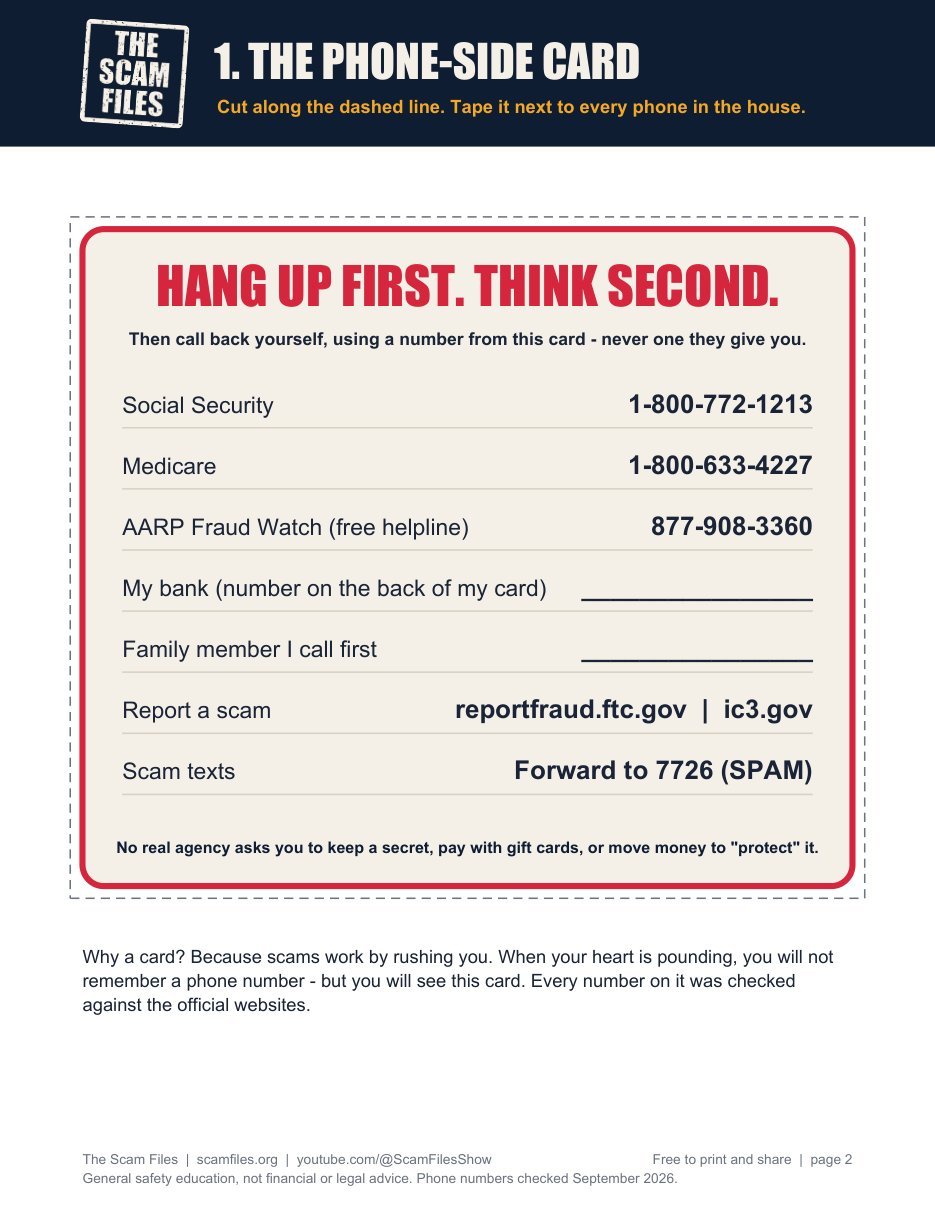
Keep this file by the phone
Print it and tape it by the phone. Six pages, free:
- The phone-side card with the real numbers
- 12 sentences that mean "hang up now"
- Your family safe word, and the 10 scams in one page
One short email a week with the newest case file. No spam, unsubscribe any time.