
The case file
The video was twenty-two seconds long. Michael's birthday — the singing, the laughing, the candles. His cousin posted it on a Saturday afternoon, and by Sunday it had forty-one likes. Most of them from people the family had never met.
One of those strangers didn't leave a like. He left with the audio. Last week, we opened the file on the call that sounds exactly like your grandchild. Tonight, we answer the question that call depends on: where did they get the voice? The answer is closer than you think — and before we're done, you'll know exactly how to take it back.
What you're watching is a dramatization. Michael and his family are composites — but every step you're about to see comes from methods documented by security researchers and reported by real newsrooms, and we'll put those sources on screen as we go.
Remember the call Margaret got in our first file — her grandson's voice, crying, at 9:14 on a Tuesday night? That call didn't start with a phone. It started weeks earlier, with a harvest. So let's walk through it, slowly, in the light of day — because once you see how ordinary it is, it loses its power.
Step one: the criminal doesn't hack anything. He searches. Public Facebook videos. Public TikToks. Graduation speeches, birthday toasts, vacation clips — anything where a voice is clear for a few seconds. In that Florida case we covered last time, the family said the voice used against them sounded exactly like their daughter — and their story ran on the news precisely because everything a scammer needed was sitting in public view.
Step two — when there's no video to find, they can simply call. Sometimes the goal is just to keep you talking for a few seconds. And sometimes it's stranger than that. Maybe you've gotten this call:
Hello? Can you hear me?
The recorded call
The Federal Communications Commission has warned about "can you hear me" calls — the concern being that a recorded "yes" could be kept and misused. Now, here's the honest part, because we promised you we'd never inflate a threat: consumer groups like the Better Business Bureau say they have no confirmed reports of anyone losing money from the word "yes" alone. So we won't tell you to be afraid of it. We'll tell you what it really is: a reminder that your voice has value to strangers — and that not answering unknown numbers costs you nothing.
And step three is the one that surprises everyone: your voicemail greeting. It's a clean, clear recording of your voice — your name, your cadence — available to anyone who dials your number and waits for the beep. Security professionals now openly warn that personal greetings have become raw material for voice cloning. You made that recording to be polite. It may be the only sample of your voice a stranger will ever need.
Here's the honest, unexaggerated science, same as last week. Researchers at McAfee tested publicly available voice-cloning tools and found that three seconds of audio was enough to produce a voice matching the original about 85 percent of the way. A few more clips pushed it to 95.
Three seconds. Michael's birthday video was twenty-two.
The software doesn't care whether the words were happy when they were spoken. It learns the instrument, not the song. Feed it laughter from a barbecue, and it can produce sobbing from a jail cell. Then the same public profiles supply the script: the grandchild's name, the grandmother's name, who lives where. That's the whole factory. No hacking. No genius. Just patience, and a family that lives out loud online — like most families do.
And the scale is real. In 2025, Americans over sixty reported more than 7.7 billion dollars in losses to the FBI's Internet Crime Complaint Center — over 201,000 victims, with losses up 59 percent in a single year. Over 3,100 of those complaints from older adults specifically mentioned artificial intelligence, with losses above 352 million dollars.
Why does the harvest work so well? Because none of this feels like a risk while you're doing it. Posting a birthday video is love. Recording a friendly voicemail greeting is good manners. Answering a call with "yes" is simple politeness. Criminals have built a business on the gap between how those things feel — and what they hand over.
And let's say it again, because it matters: if a voice from your family ever gets copied, no one did anything wrong. Your grandson isn't careless for having a TikTok. You aren't careless for having voicemail. But there are four adjustments — most of them take under five minutes — that close the harvest down. Here they are. This is the Lockdown Plan.
Step one: go private. This weekend, sit down with your family — especially the grandkids — and change who can see your videos. On Facebook, set posts and videos to "Friends" instead of "Public." On TikTok and Instagram, switch to a private account, so only approved followers see anything with a voice in it. The memories stay. The strangers go. This one step removes the biggest voice supply criminals have.
Step two: new voicemail. Replace your personal voicemail greeting with your phone company's default robot greeting — the flat voice that just reads back the number. On an iPhone, it's Phone, then Voicemail, then Greeting, then "Default." On most other phones, your voicemail settings have a reset option, or your carrier can do it in one call. A robot greeting gives a voice thief nothing to steal.
Step three: never say yes. Let calls from unknown numbers go to voicemail — real callers leave messages. And if you do pick up and a stranger opens with "Can you hear me?", don't answer the question. Just hang up. You owe a stranger nothing, not even one word.
Step four: safe word. If you watched our first file, you've already done this. If not, tonight's the night: pick one silly, private word or phrase with your family. A copied voice can pass almost every test — except a memory. This is the step that protects you even if a voice does get harvested, and that's why it's on both lists.
Go private. New voicemail. Never say yes. Safe word. Four steps, one quiet afternoon, and the harvest comes home empty.
If you believe a voice in your family has already been copied — or you got the call — do these things today. Warn the family, so the safe word is fresh. Report it to the FBI at IC3 dot gov and to the FTC at ReportFraud dot FTC dot gov — those reports are how prosecutions start. And if you want to talk it through with a real person first, AARP's free Fraud Watch helpline is 8 7 7, 9 0 8, 3 3 6 0, whether you're a member or not. And remember what we said last week: being targeted by professionals is not a mistake you made.
In our dramatization, this is where the file closes: not with a loss, but with a grandson and a grandmother spending ten minutes on a porch, quietly taking their voices back.
So here's your homework, and it's a family project. Send this video to the person in your family who posts the most — you know exactly who that is — and do the four steps together: go private, new voicemail, never say yes, safe word. It costs nothing, and it'll probably turn into a nice phone call.
And if you'd like company doing this every week, subscribe. Next time, we open a file on the message that looks like it came from your bank — down to the logo, the phone number, and the fear. Until then: let the unknown numbers ring.
I'll see you at the next file.
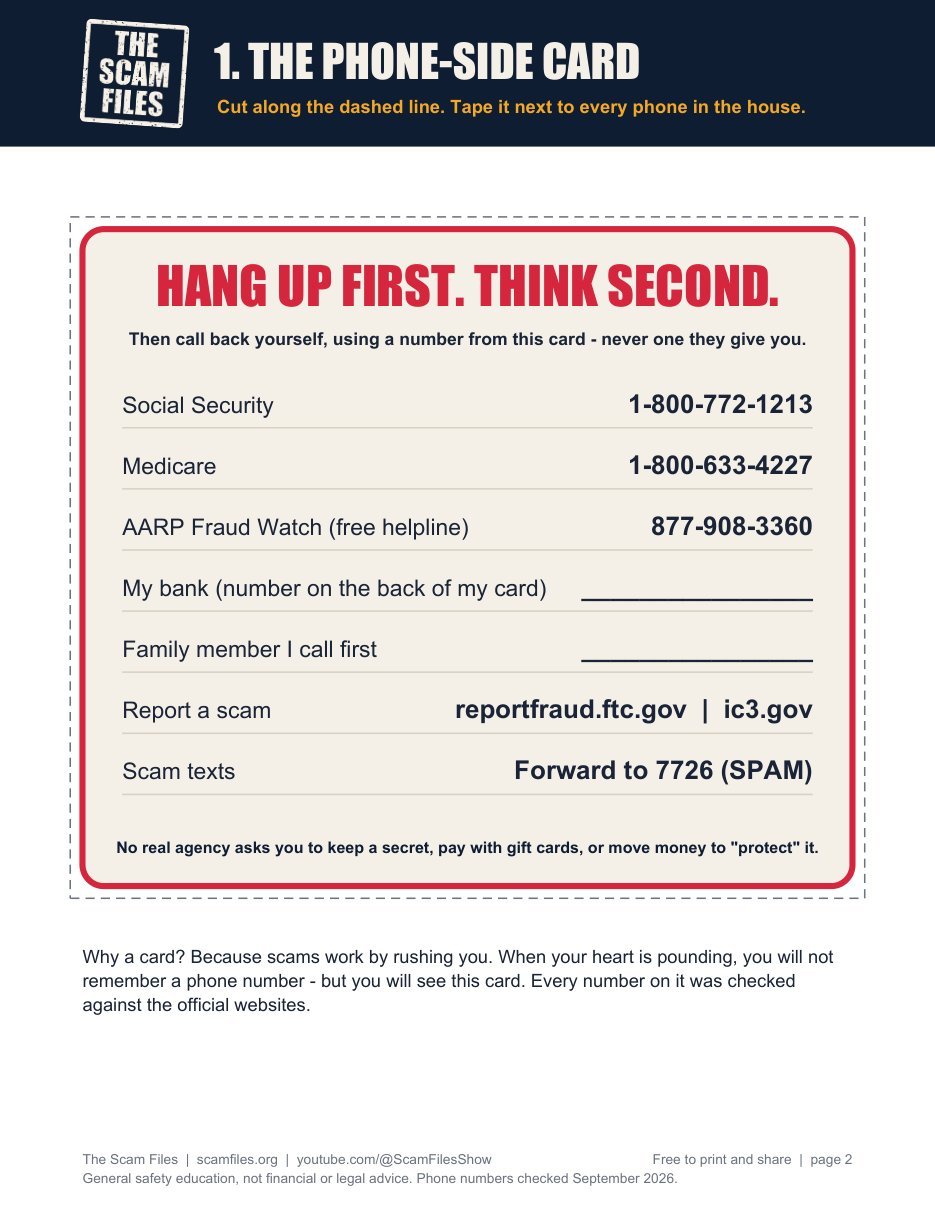
Keep this file by the phone
Print it and tape it by the phone. Six pages, free:
- The phone-side card with the real numbers
- 12 sentences that mean "hang up now"
- Your family safe word, and the 10 scams in one page
One short email a week with the newest case file. No spam, unsubscribe any time.