
The case file
One dollar and ninety-nine cents. That's what the text asked Eleanor to pay. She never paid it. She didn't have to. By the time she closed the page, they already had everything they wanted.
Last week we opened the romance scam, all seven stages. Tonight's file is faster. It doesn't take seven months. It takes about four minutes, and it arrives on the busiest shopping weeks of the year, when every one of us is waiting on a package.
According to the FTC, the most reported scam text in America is a fake package delivery message, usually pretending to be the U.S. Postal Service. Scams that started with a text cost Americans four hundred seventy million dollars in a single year, five times what was reported just four years earlier. And that's only what people reported.
What you're watching is a dramatization. Eleanor is a composite character, and every step you're about to see comes from methods documented by the FTC, the FBI, the Postal Inspection Service and security researchers who took these kits apart. We'll show you the text itself, second by second, then the machine behind it, and then the five-minute plan that makes this scam useless against you.
It was the second week of December. Eleanor had ordered a gift for her granddaughter, Chloe, a knitted blanket from a small online shop, and she'd been checking the tracking every morning like a child waiting for Christmas. So when her phone buzzed with a text from a number she didn't recognize, she didn't think twice about reading it.
"USPS: Your package is on hold at our facility due to an incomplete address. To schedule redelivery, a fee of one dollar and ninety-nine cents is required. Please update your information within twelve hours."
Let's slow that message down, because every word of it was written by someone who studies how people react.
"On hold." Not lost, not cancelled. On hold, which means you can still fix it. "Incomplete address," a small, believable mistake, the kind anyone could make at checkout. "One dollar and ninety-nine cents," an amount too small to argue about. Nobody calls their bank over a dollar ninety-nine. And "twelve hours," a deadline short enough that you act now, and long enough that it doesn't feel like pressure.
Then there was one more line at the bottom.
"Please reply Y, then exit the text message and reopen it to activate the link."
That line is the cleverest part of the whole text, and almost no one knows why it's there.
Your iPhone protects you, quietly. When a text arrives from a number that isn't in your contacts, the phone switches the links off, so you can't tap them by accident. The only way to switch them back on is to reply. So the scammers simply ask you to reply. One letter. Y. The moment Eleanor typed it, two things happened. The link came alive. And somewhere, a computer marked her number as a person who answers.
She tapped the link.
The page that opened was perfect. The eagle logo. The blue and red stripe. A tracking number. A little map with a pin on it. "Your package could not be delivered. Please confirm your address and pay the redelivery fee." She typed her name, her street, her zip code. Then the page asked for her card, to cover the dollar ninety-nine.
She started typing the number. Then she stopped. Something about it felt off. Maybe it was the web address, which said something like "usps dash redelivery dash help dot com." She closed the page without pressing the button. She felt relieved. She'd caught it in time.
She hadn't.
Security researchers who have taken these scam kits apart found something that should change how all of us think about a fake page. The kits record every character the moment you type it, in real time, whether or not you ever press "submit." The name. The address. Every digit of the card number, the expiration date, the three numbers on the back. Closing the page doesn't take anything back. It was gone the moment her fingers touched the keys.
Now here's where it goes from a stolen card number to something much worse.
About a minute later, Eleanor's phone buzzed again. This time it was a real text, from her real bank. "Your verification code is four eight two nine one three. Do not share this code with anyone."
At the same moment, the fake page she'd closed popped back up in her browser. "Almost done! Enter the verification code we just sent to confirm your payment of one dollar and ninety-nine cents."
It all lined up. The fee. The code. The timing. So she typed it in.
That code had nothing to do with a dollar ninety-nine. While Eleanor was reading her text messages, somebody on the other side of the world was sitting with her card number in one hand and a phone in the other, adding her card to Apple Pay on their phone. The bank did exactly what a bank should do: it sent a code to the real owner, to make sure it was really her. And the fake page asked her to hand that code over.
The moment she typed it in, her card lived on a stranger's phone.
Researchers who study these gangs have photographed what happens next: crates of phones, each one loaded with several stolen cards, labeled by hand and sold in bulk. A phone with your card inside it can be carried into any store in the world and tapped at a register like it belongs to you. Researchers estimate a hundred to five hundred dollars in fraud on each stolen card, and a single kit can steal thousands of cards a day.
For three days, nothing happened. That's on purpose too. Then the charges started: an electronics store two states away, a gift card rack, a gas station, all small, all tapped with a phone.
So who sends these texts? Not one lonely scammer. A business.
In November of 2025, Google filed a federal lawsuit, under the same racketeering law that's used against organized crime, against the people behind a scam kit called Lighthouse. It's a phishing service, rented out to criminals like software, with ready-made fake websites for the Postal Service, for toll roads, for banks, even for Google itself. Google said Lighthouse had harmed more than one million victims in more than one hundred twenty countries. Researchers linked it to more than seventeen thousand fake websites imitating three hundred sixteen brands. One estimate put the number of American cards stolen at somewhere between twelve million and one hundred fifteen million.
Lighthouse went dark after the lawsuit. The texts didn't stop. When one kit disappears, another one is for sale by the next week.
And the package isn't the only costume. The FBI has warned about the same kind of text pretending to be your state's toll road. "We've noticed an outstanding toll amount of twelve dollars and fifty-one cents on your record. To avoid a late fee of fifty dollars, visit this link." Same small amount. Same deadline. Same fake page. Same code. The FBI received more than sixty thousand complaints about toll texts in a single year.
Here's the one fact that makes all of these fall apart. The Postal Inspection Service says it plainly: the Postal Service will not text you unless you signed up for text updates yourself, with a tracking number. And even then, the message will not contain a link. Not ever. A text from the Post Office with a link in it is not from the Post Office.
Grandma, look at this. Four hundred and eighty-seven dollars at an electronics store in Ohio? You've never even been to Ohio. Okay. Don't panic. Give me your card, let's call the number on the back, right now. Not any number from a text. The one on the card.
Chloe
This is where our dramatization turns.
Chloe had come by with groceries and saw the charge on her grandmother's banking app, and she didn't waste a minute being upset. She flipped the card over and dialed the number printed on the back. Eleanor put the phone on speaker.
Mrs. Whitfield, thank you for calling. I can see the charges you're describing. I can also see your card was added to a mobile wallet on a new device on December ninth. That wasn't you, was it? Okay. I'm removing that device right now, closing this card, and sending you a new one. You won't be responsible for these charges. And for the future, we will never ask you to read us a code, and that code was never for a delivery fee.
The real bank
Four hundred eighty-seven dollars that Eleanor didn't have to pay, because she called the same day, and because she called the number on the card.
Before we get to the plan, let's be honest about why this works on careful, smart people, because Eleanor is careful. She didn't press "submit." She noticed the web address. She did almost everything right. The scam didn't beat her carelessness. It beat three things we're all taught to trust: a familiar logo, a tiny amount of money, and a code from our own bank. It doesn't feel like a robbery, because nothing about it looks like one. It looks like errands.
And the timing is chosen, too. The weeks between Thanksgiving and Christmas, when all of us are expecting packages, are exactly when these texts spike. The FTC says the most commonly reported scam texts pretend to be about deliveries for the same reason a pickpocket works a crowded train. Everyone's distracted.
The plan
Here's the plan. Five steps, and the first one takes ten seconds.
Step one: never tap a link in a text about a package or a toll. Not even to look. If you ordered something, open the store's app or website yourself, the way you always do, and track it there. If you think you owe a toll, go to the toll road's real website or call the number on your statement.
Step two: never reply to a text from a stranger. Not with a Y, not with "stop," not with "who is this." A reply switches on the links and tells them your number is alive. Just delete it, or forward it to seven seven two six, which spells SPAM, so your carrier can block it for everyone.
Step three: a verification code is a key to your account, not a receipt. If your bank texts you a code you didn't ask for, somebody somewhere is trying to use your card. Don't type it anywhere, don't read it to anyone, and call your bank.
Step four: if you typed your card number into a page you're not sure about, even if you never pressed submit, call your bank that same day. Use the number on the back of the card. Ask them two things: to cancel and reissue the card, and to remove any mobile wallets or devices connected to it.
Step five: turn on alerts. In your bank's own app, switch on text or email alerts for every purchase and for any new device added to your card. Eleanor's bank would have told her the moment her card landed on a stranger's phone, instead of three days later.
If it already happened
If this already happened to you, you're in good company, more than a million people, and it's fixable. Call your bank using the number on your card. Forward the text to seven seven two six. Report it to the Postal Inspection Service at spam at u s p i s dot gov, and to the FTC at report fraud dot F-T-C dot gov. If money moved, file at I-C-3 dot gov. And if you'd like to talk it through with a real person, AARP's Fraud Watch helpline is free: eight seven seven, nine oh eight, three three six oh.
In our dramatization, this is where the file closes. Chloe sat with her grandmother at the kitchen table and turned on purchase alerts in the bank's app, and they made a new family rule: every package gets tracked from the store, and every text with a link gets deleted. The blanket arrived two days later, the old-fashioned way. The mail carrier knocked.
Here's your homework, and it's the easiest one yet. Open your bank's app tonight and turn on purchase alerts. Then send this video to one person who does their holiday shopping online.
This case file is closed. Next time: the phone call from someone who says they're from the Social Security Administration, and that your number has been suspended. It hasn't. New file every week. Subscribe so you're never caught off guard.
- FTC — Top text scams (2025): https://www.ftc.gov/news-events/news/press-releases/2025/04/new-ftc-data-show-top-text-message-scams-2024-overall-losses-text-scams-hit-470-million
- FTC — Fake USPS texts: https://consumer.ftc.gov/consumer-alerts/2025/04/think-text-message-usps-it-could-be-scam
- USPIS — Package tracking text scams: https://www.uspis.gov/news/scam-article/smishing-package-tracking-text-scams
- FBI IC3 — Unpaid toll smishing: https://www.ic3.gov/PSA/2024/PSA240412
- KrebsOnSecurity — How phished data turns into Apple & Google wallets: https://krebsonsecurity.com/2025/02/how-phished-data-turns-into-apple-google-wallets/
- Google v. Lighthouse (CNBC, Nov 2025): https://www.cnbc.com/2025/11/12/google-e-zpass-usps-text-scam-phishing-suit.html
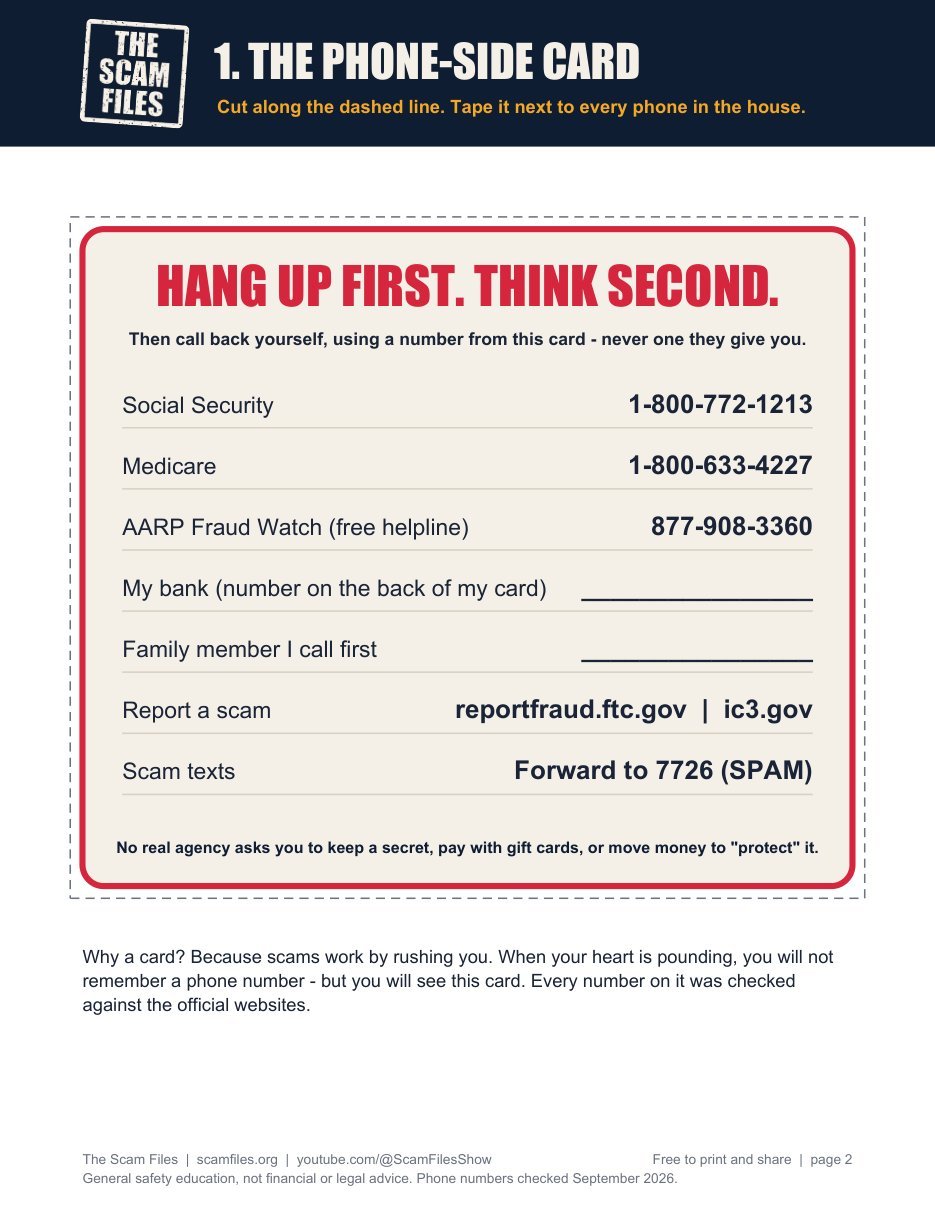
Keep this file by the phone
Print it and tape it by the phone. Six pages, free:
- The phone-side card with the real numbers
- 12 sentences that mean "hang up now"
- Your family safe word, and the 10 scams in one page
One short email a week with the newest case file. No spam, unsubscribe any time.